Why these two towns are sold as one trip
The Pahang and Kelantan vacation package is built around a railway rather than around two places that happen to sit near each other. Kuala Lipis stands where the Lipis runs into the Jelai, well inside the middle of the peninsula. Kota Bharu stands near the mouth of the Kelantan river, close to the sea. The line through the interior joins them directly, and doing the same distance by road means a longer day looking at highway.
So we sell the two ends and the ride as one item. The figure you see is the Kuala Lipis stay and the Kota Bharu stay put together with the seat between them. Buying it as one trip does not move the number in either direction, and we are not going to pretend otherwise. What you get for handing it to us is that the two stays, the seat and the transfer at the far end are arranged to fit the train instead of the other way around.
Two nights in Kuala Lipis
Kuala Lipis was the seat of the Pahang administration from the end of the nineteenth century until 1955, when everything moved to Kuantan, and the town has been quietly getting on with itself ever since. That history is the reason a place this size has the buildings it has. The district offices, the old school and the residence on the hill were put up for a capital, and they are still there, in varying states, with grass growing where the lawns were mown.
You walk it. The hill takes twenty minutes up from the station and the buildings along it are worth the climb for the woodwork and the deep verandahs. Down at river level there is the covered market, which is at its busiest early and where the fruit and the river fish and the dry goods are worth going through slowly. There was gold in this district long before the British arrived and the town grew on the back of it; the workings are out of town and mostly overgrown, and what survives in the center is the shape of a place that once had money passing through it.
Two nights is the right amount. There is a day of walking here and an evening of sitting by the water, and on the second morning you are packing for the train. Anyone who needs a lot going on in the evening will find this town very quiet after dark.
Three nights in Kota Bharu
The central market is the first thing to do and the earliest. It is a hall on several levels with the produce sellers on the ground floor working from before dawn, the dry goods and cloth above them, and food to eat upstairs. Go at first light on your first full morning. By eleven the ground floor is thinned out and the heat has arrived.
North of town, on the road toward the river mouth and the villages that side, is where the craft work is. Batik is printed and painted in open workshops you can walk into, songket is woven on frames by hand and takes a long time to do, there are silversmiths working small pieces, and there are people building kites out of bamboo and paper. None of it is set up as a show. You are walking into somebody's working shed, so ask before you photograph anything and expect to be offered tea.
Round the padang in the middle of town there is a cluster of museums in old royal and government buildings, and they are small, inexpensive to enter and worth two or three hours between them. Add the food, which is the real reason many people come to Kelantan: rice dishes colored blue, rice cooked in coconut milk and eaten with fish curry, grilled chicken in a thick sauce, and a whole range of sweet things sold from stalls in the afternoon. Three nights gives you a market morning, a craft day, a museum half day and enough spare time to go back to whichever of those you liked.
Practical note on the town. Dress is more covered here than on the west coast, so long sleeves and long pants or a long skirt will have you looking like everybody else and will also keep the sun off. The working week runs differently too: counters and many shops are quiet on Friday and Saturday and open on Sunday, and we set your market mornings and museum day around that.
How tied together the days are
This is the most tied trip we sell, and it is fair to say so before you commit. The train north runs a few times a day and no more, so the day you leave Kuala Lipis is decided by the timetable, not by you. Your second night in Kuala Lipis has to be the night before a service that runs. Your arrival into Kota Bharu is whenever the train gets in, and the road transfer waits for the train rather than for a clock.
At the far end the same thing happens in miniature. The market works early, so your first full morning in Kota Bharu is spoken for. The craft workshops keep ordinary working hours and are shut when they are shut. Put those together and almost every hour of the five nights has a reason to be where it is.
If you like deciding at breakfast what you will do that day, this is the wrong trip and we would rather you took one of the single places instead. If you like the idea of a plan that hangs off one train, this is exactly what it is.
The move in the middle
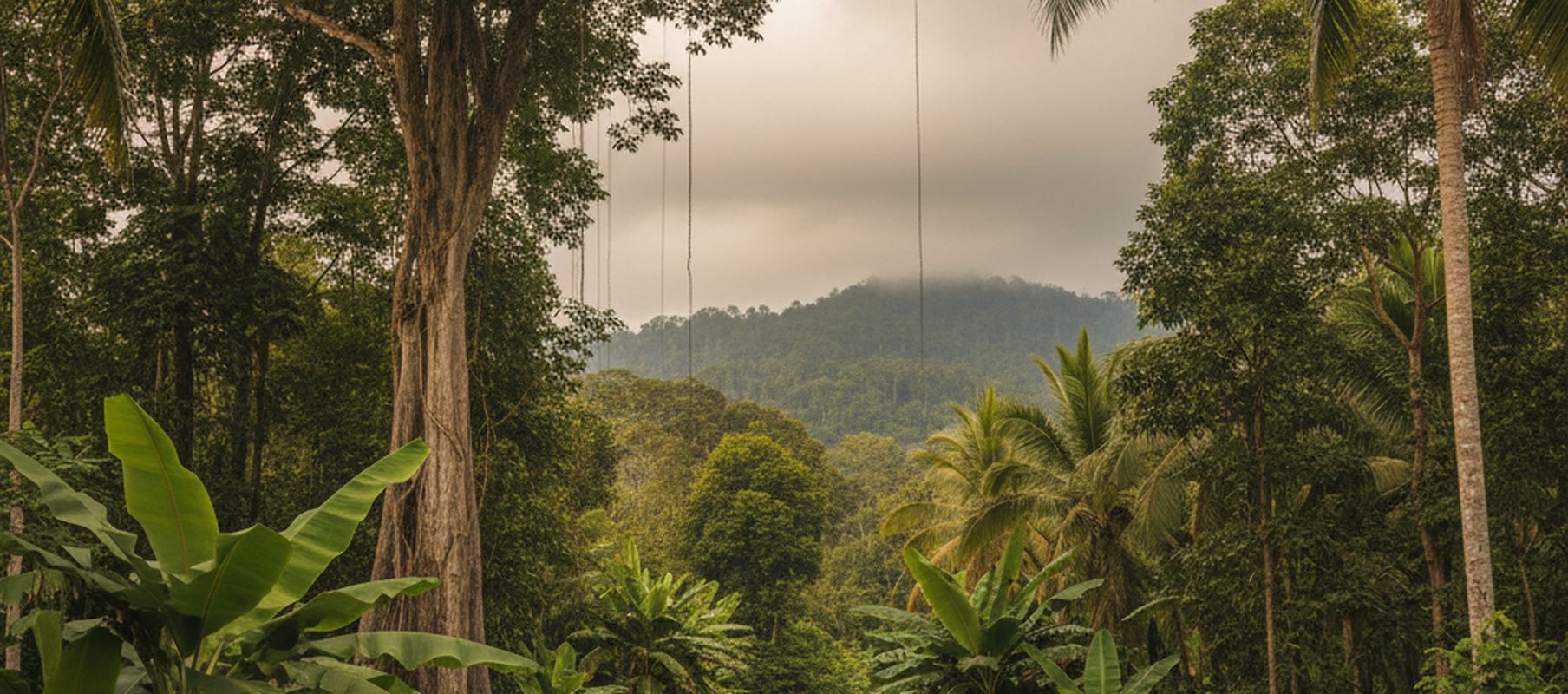
It is a slow train and it is meant to be. You leave Kuala Lipis and for the first stretch it is rubber and oil palm in rows, then the rows stop and the trees close in properly, and for long periods there is nothing out the window but green wall and a cutting of red earth. The line climbs and drops through the middle of the peninsula, crosses rivers on old steel bridges, and pulls up at halts that are a concrete platform, a shelter and a track across to a village. At some of them one person gets on. At some nobody does and you go again after a minute.
The carriages are ordinary. There is air conditioning on the newer units, the seats recline a little, and there may or may not be anything to buy on board, so bring your own food. Toilets are basic. People sleep, children run the aisle, somebody will almost certainly want to talk to you and the conversation will be in a mix of Malay and English and will be friendly. What you see out the window depends entirely on the day and on the weather, and nobody can promise you mist in the valleys or an animal beside the track. The ride is the thing you came for, and it is long, and by the end of it you will be tired in a good way.
- How
- A seat on the interior line, north from Kuala Lipis to Wakaf Bharu, then a short road transfer into Kota Bharu.
- How long
- Most of a daylight ride. We put the exact departure and arrival in writing when your seats are held rather than quoting you a number now.
- How often
- A handful of services a day at most, and the pattern on this stretch has been changed, cut and restored more than once over the years. We confirm the timetable that is actually running in your week before you commit to anything.
- Who runs it
- For somebody who can sit still for hours with a book, a bottle of water and something to eat. Not for anyone who needs to be somewhere by a fixed hour, and not for anyone who wants to be entertained.
Each end taken by itself
- Reserve the Kuala Lipis vacation package, 2 nights, $610 on its own
- The Kota Bharu vacation package, 3 nights, $890 on its own
Two nights inland, a full day on the train, three nights on the coast, and one price covering the ground from the moment you reach Kuala Lipis.
Clocks that run this pair
- Day 1. You reach Kuala Lipis under your own steam and check in. Afternoon free, evening by the river.
- Day 2. Kuala Lipis on foot: the hill and the administrative buildings in the morning, the covered market and the riverfront after. Early night, because tomorrow starts early.
- Day 3. The ride north on the interior line. Forest, rubber, oil palm and a long string of small halts. Met at Wakaf Bharu and driven the short distance into Kota Bharu.
- Day 4. The central market at first light, then the museums round the padang when the heat comes up.
- Day 5. The craft road north of town: batik, songket, silver and kites, at your own pace. Day 6 you leave from Kota Bharu.
What the figure holds and what it leaves to you
Held inside the figure
- Two nights in Kuala Lipis and three nights in Kota Bharu, one room for two people sharing, with whatever breakfast the house serves.
- A reserved seat on the interior line from Kuala Lipis north to Wakaf Bharu.
- The road transfer from Wakaf Bharu station into Kota Bharu, roughly 5 km, timed to the train and not to a clock.
- A half day on foot in Kuala Lipis with somebody who lives there, covering the hill, the old buildings and the market.
- A morning at the central market in Kota Bharu with somebody who can tell you what you are looking at.
- A written day sheet with the times the line is actually running in your week, sent before you pay the balance.
Left outside it, on purpose
- Getting yourself to Malaysia and home again. This price covers the ground only and starts when you arrive in Kuala Lipis.
- Travel from Kuala Lumpur, or from wherever you land in the country, up to Kuala Lipis at the start of the trip. We will tell you how to do it, by road or by rail, but it is not in the number.
- Onward travel out of Kota Bharu on your last day, by whatever means you choose to leave.
- All lunches and dinners, plus anything you eat or drink on the train, which is why we tell you to carry food and water on board.
- Museum entry round the padang and anything you buy on the craft road north of town, from a length of batik to a finished kite.
- Taxis you take on your own account in either town, laundry, and anything you arrange directly with people you meet along the way.
A price on this site covers the ground only: the rooms, the named transfers between them, and the people who meet you. It does not cover getting to the country or leaving it.
Three things are confirmed to you in writing before any balance is due: the service on the interior line that your trip is built around, the departure and arrival times for that service in your week, and the driver meeting you at Wakaf Bharu. If the line is not running your section when your dates come up, we tell you and you decide whether to move the dates or take the two places separately.
The months this pair holds together
March to September is the drier stretch on this coast and the part of the year when the interior line normally runs its full pattern. That does not mean a dry week. It rains hard and briefly most afternoons inland at any time of year, and we are not going to tell you what the sky will do on your particular days. What it does mean is that the roads round Kota Bharu are open, the craft workshops are working and the trains are keeping to whatever schedule is in force.
November to February is the northeast monsoon, and on the Kelantan coast it is the real thing rather than a bit of rain. Wind comes straight in off the sea, rain falls for days rather than hours, much of the coast north and south of Kota Bharu closes down, small boats stay in, and in bad years the low ground beside the interior line floods and services on it are cut or stopped while the track is put back. We do not run this pair in those months. If you ask us for a date in that window we will tell you no and offer you the shoulder of it instead.
Asked about this one more than once
- Which station do I actually arrive at, and how far is it from Kota Bharu?
Wakaf Bharu, which is over the river in Tumpat district and roughly 5 km from the middle of Kota Bharu. It is a short drive and it is in your price. There is no station in the city itself, so everybody arriving by rail does this last bit by road.
- How many trains a day go north from Kuala Lipis, and how long does it take?
Not many, and we are not going to print a figure here that might be wrong by the time you read it. This section has been suspended, repaired and put back at different points over the years and the pattern has changed with it. We check what is running for your dates and send you the actual times before you pay the balance. Plan on the ride taking most of the daylight.
- Can I do the two towns separately instead of as a pair?
Yes. Kuala Lipis and Kota Bharu are both in the catalog on their own and you can take either without the other. The price of this pair is the two stays put together with the seat between them, so taking them as one trip does not change what you pay. What you get from the pair is that we build both ends around the train, which is the part that is hard to do from a distance.
Reserve a month rather than a date
Tell the office which month you have in mind and it will answer with what that month makes possible and what it shuts.