What the four nights actually cover
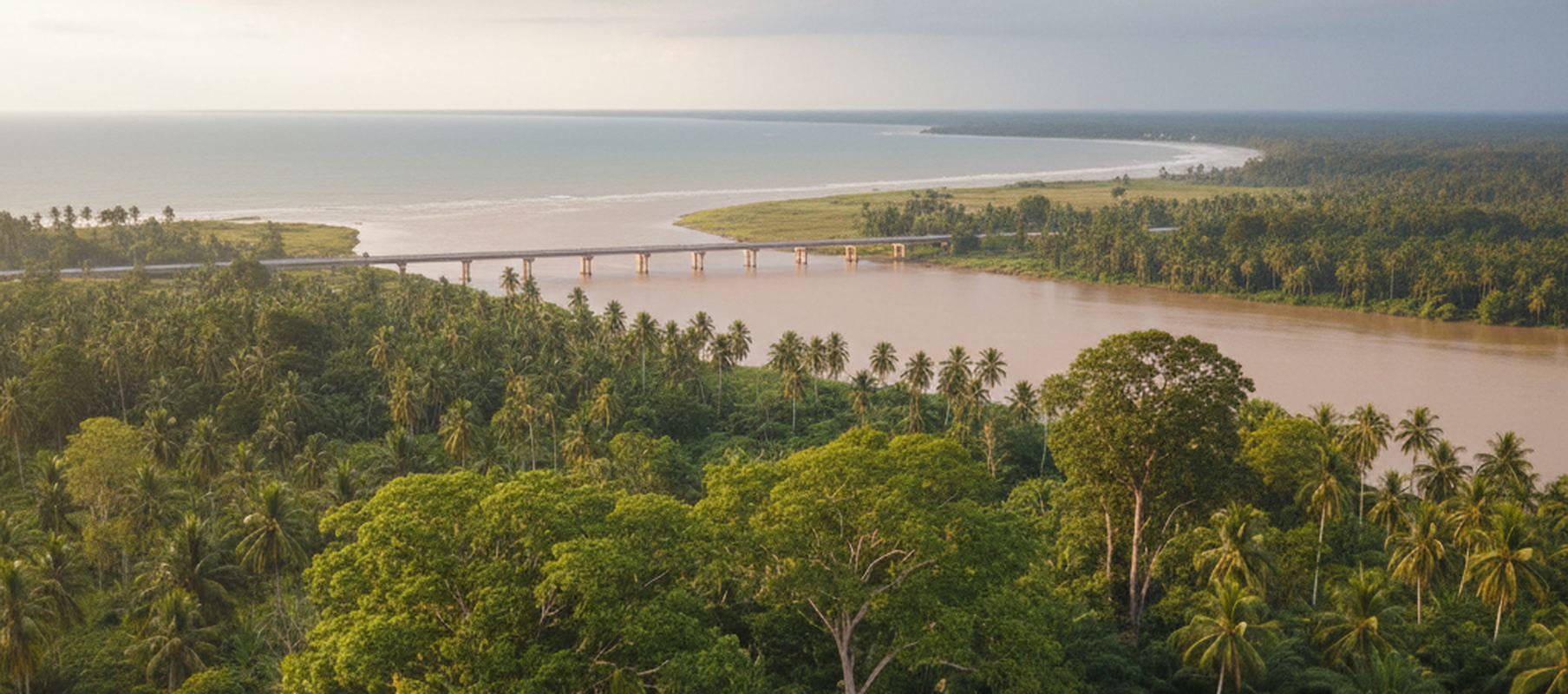
The Kuala Terengganu vacation package gives you four nights beside the mouth of the Terengganu river, on the mainland coast, at the point where brown water turns and runs out into the South China Sea. The office arranges the ground part and nothing else. It books no flight and no sea crossing, so getting yourself into the country is your own business, and the offshore islands are not in this itinerary at all.
This is a working river first and a place to look at second. Wooden fishing boats tie up two and three deep along the banks, ferries cross it all day, and a bascule bridge with a double leaf spans the mouth, open to traffic since 2019. Expect engine noise early in the morning. Anyone after a quiet strip of sand with a pool behind it should take a different page in this book.
One morning in the four is pinned to somebody else's clock and the rest are yours. The city is small enough to walk. Distances that need a car, meaning the boatyards across the water and the road south, are short. What the days ask of you is patience with heat, with wet air, and with places that shut when their owners feel like shutting.
Wood, props and a yard that is still in business
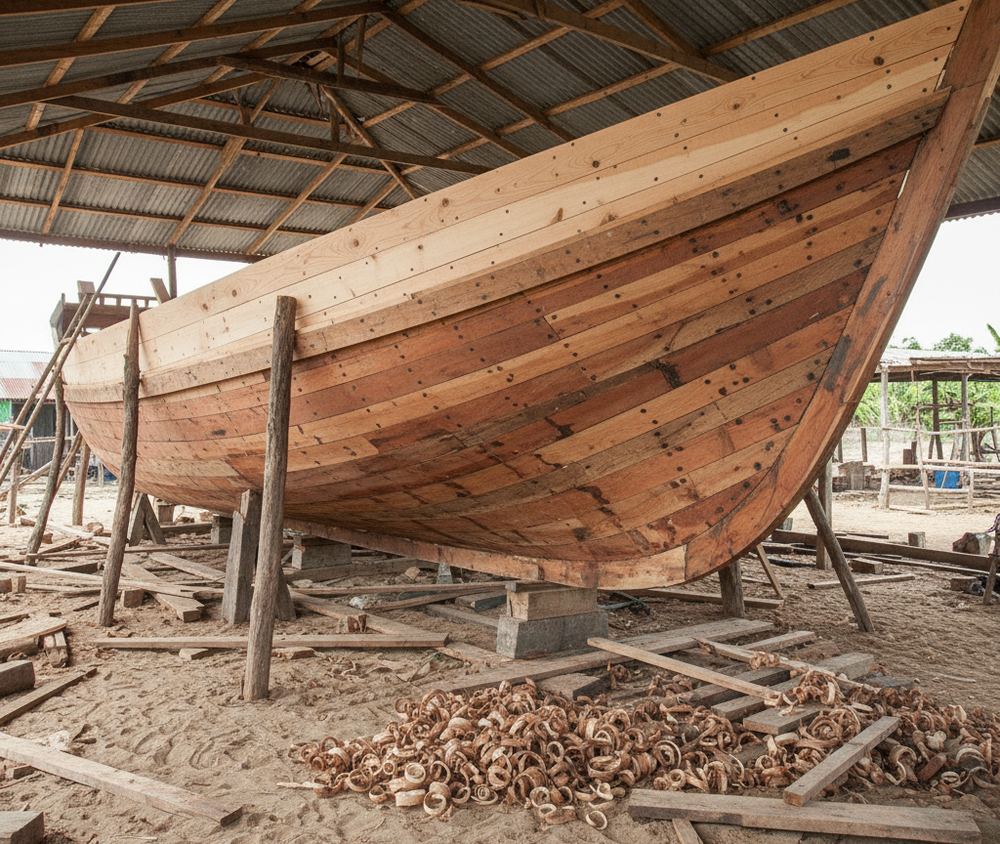
Duyong sits in the river mouth, a little over a square kilometer of sand and houses, joined to the city and to Kuala Nerus by the Sultan Mahmud Bridge. You reach it by road or by one of the roofed wooden ferries from the jetty beside the market. Boats have been built and repaired here in timber for generations, shaped over bent frames, and the older method used wooden pegs rather than nails.
The trade has been shrinking for years and there are fewer sheds than there were. That is the honest state of it. The office arranges the morning with a yard that is working, so somebody will be there and somebody will talk, but nobody can promise a hull on the stocks at the size you imagined. Some mornings it is repair work on a fishing boat, sanding and caulking and nothing more dramatic.
Wear closed shoes. The ground is sand, sawdust and offcuts, and there are tools underfoot. It is loud and it is hot under a zinc roof. Also on the island is Kota Lama Duyong, the old house of Tok Syeikh Duyong, a religious teacher who lived from 1802 to 1889, with carved timber and an odd mix of European and Islamic detail.
The shophouse street and the crossing at Shahbandar
Jalan Kampung Cina is two facing rows of shophouses, some of them prewar and a few older than that. Ho Ann Kiong, the Chinese temple partway along, dates to 1801, and there is a well from 1875 set into the street. The lane has been tidied for visitors, with lanterns strung overhead and painted walls, and some units are shuttered. It is short. You can walk it end to end and back without rushing.
Behind it, on Jalan Sultan Zainal Abidin, the Shahbandar jetty puts you on the water. The crossing boats are wooden, roofed and engined, and they go over to Seberang Takir on the north bank and to Duyong. You pay in coins on board. They run in daylight and stop for the night, which is the one thing in these four nights you have to plan around.
Bukit Puteri, the small hill by the market, is a stepped climb with old cannons and a bell at the summit. It is short and it is steep, and in the middle of the day it is punishing. Istana Maziah stands at the foot of the hill and is a working royal palace, so it is normally closed and you look at it from the road.
Cloth and brass on the floor above the fish
Pasar Besar Kedai Payang stands on Jalan Sultan Zainal Abidin next to the jetty. The wooden market of 1964 came down in 2019 and what stands now is a new concrete building, so do not come for old timber. The ground level is wet stalls, fish, vegetables and trays of kuih. The floor above is cloth, meaning Terengganu batik, silk, brocade and songket.
Songket is the one to understand before you spend. The ground cloth is silk or cotton and the pattern is a second weft of metallic thread laid in by hand on a wooden frame loom, which is why a hand woven length costs many times what a machine woven one costs. Ask which is which and ask to see the reverse. Motif names are worth learning, pucuk rebung, the bamboo shoot triangle, first.
Brass shares that floor. Betel boxes, trays and lidded bowls, some of it made here and some of it not, and a seller will usually tell you straight if you ask where a piece came from. Nothing is priced on a label. If haggling makes you uncomfortable, bring somebody who enjoys it or accept that you will pay the first number said.
Rice in the morning, and the road down to Marang
Nasi dagang is breakfast. Rice steamed with coconut milk, shallots, lemongrass and fenugreek, a tuna curry over it, pickled cucumber and carrot on the side. The Terengganu version uses plain white rice and is simpler than the Kelantan one. Stalls cook a quantity and when it is gone it is gone, so this is an early meal or no meal. Nasi kerabu, rice turned blue with butterfly pea flowers, herbs, salted egg and budu, comes later in the day.
Keropok lekor is the thing people mean when they say Terengganu. Sea fish ground with sago or tapioca flour and salt, rolled into ropes, boiled, then fried until the outside goes rough. Losong is the name attached to it. It is chewy and it smells strongly of fish, and plenty of people try one and stop. The thin dried version, sliced and crisped, is easier to like.
The last full day runs south on Federal Route 3 toward Marang, the next district town down the coast, through fishing settlements where boats are pulled up on the sand. Manage your expectations about the driving. For long stretches the road sits behind houses and trees and you do not see water at all, and there is traffic. Terengganu is a conservative state, shoulders and knees covered is normal, and evenings end early.
What here answers to somebody else and not to you
- One fixed thing, and it is the boatyard morning on Duyong. The yards are businesses and not exhibits, so they work the Terengganu week, which is Sunday to Thursday. Friday and Saturday are the state weekend here, not Saturday and Sunday, and the office sets your yard morning on a working day and tells you which one before you pay.
- The wooden crossing boats from the Shahbandar jetty run in daylight and tie up for the night. If you cross by water you are inside the boatman's day, not your own. The Sultan Mahmud Bridge carries the road to Duyong at any hour, so a missed boat costs you a drive, not a day.
- Nothing else is booked to a clock. The market, Jalan Kampung Cina, Bukit Puteri and the drive south are all open ended, and you can move them between the three loose days or drop them.
- The fish landings at the river mouth answer to the boats and the weather, not to a timetable anybody publishes. Go early and take what is happening. The office will not tell you a time for this because there is not one.
The hatching beside each price says how much of the trip runs to somebody else's timetable: one line for none of it, four for a trip built around fixed departures from the first morning to the last.
What the figure holds and what it leaves to you
Held inside the figure
- Four nights on the mainland coast in a small waterfront place of a middle standard, one room for two people sharing.
- Ground transport within the city, out to Duyong and down the coast road, in a car with a local driver.
- The boatyard morning, arranged in advance with a yard that is actually working that week.
- A walk through Jalan Kampung Cina, the jetties and the market with somebody who speaks Terengganu Malay.
- Two breakfasts of local rice dishes, taken where they are cooked rather than in a dining room.
- Admission charged at any site the itinerary enters, including the old house on Duyong.
Left outside it, on purpose
- Getting to Malaysia and home again. The office books no flight of any kind.
- Any passage by sea. Nothing on this itinerary goes past the river mouth and the offshore islands are not part of it.
- Lunches and dinners, which you order and pay for as you go.
- Anything bought in the market, cloth and brass included, and any commission on it.
- Travel between Peninsular Malaysian towns before or after these four nights.
- Laundry, phone, tips and everything else personal.
A price on this site covers the ground only: the rooms, the named transfers between them, and the people who meet you. It does not cover getting to the country or leaving it.
Nothing is held until the office writes to you with the dates, the room, the driver and the day of the boatyard morning in one message, and you agree to that message in writing.
The months this one is worth the journey
The northeast monsoon closes down large parts of this coast. It sets in around November and holds through December, January and February, and the Malaysian Meteorological Department counts November, December and January as the wettest months on the east coast. It means rain in long spells rather than afternoon showers, heavy seas, small boats staying in, roads under water and family run places closing for weeks at a stretch. The office does not put these four nights in the book from November to February, and if you ask for them anyway it will say no.
March through September is when this runs. Rain still falls and storms in the afternoon are ordinary in any month, but the long spells have gone, the yards are working, the market is stocked and the coast road is passable. It is hot and the air is wet enough to soak a shirt by nine in the morning. Nothing on this page promises you sun, and a gray four days is an ordinary outcome.
What this one will join to
- east coast Malaysia vacation package: Kota Bharu and Kuala Terengganu, Car and driver, coast road south on Federal Route 3, About two hours twenty minutes of driving, half a day if you stop
Tell the office your dates and how many of you there are, and it will write back with what it can hold.
Asked about this one more than once
- Does any part of this go out to sea?
No. The office arranges no sea passage at all. The wooden ferry between the jetty and Duyong is a short crossing of the river inside the mouth, and Duyong also has a road bridge. The offshore islands are not on this itinerary and all four nights are on the mainland coast.
- What happens if we land on the state weekend?
In Terengganu the weekend is Friday and Saturday, not Saturday and Sunday, so state run places and most workshops are closed then. The office puts the boatyard morning on a working day for exactly that reason. Jalan Kampung Cina, the market and the coast road are not state run and keep their own hours.
- What is the price on this page actually for?
It is per person for the ground arrangements over four nights, worked out on two people sharing one room. It does not cover getting yourself into Malaysia, meals beyond the two breakfasts, or anything you buy. A person traveling alone pays more, and the office will quote that separately.
Reserve a month rather than a date
Tell the office which month you have in mind and it will answer with what that month makes possible and what it shuts.